History with its flickering lamp stumbles along the trail of the past, trying to reconstruct its scenes, to revive its echoes, and kindle with pale gleams the passion of former days. ~Winston Churchill

Showing posts with label Canada. Show all posts

03 April, 2015

Friends Being Ridiculous, 1897

A quick, fun set! I don't have a tremendous amount of context for these photographs, which come from what appear to be two sets, in a collection held by a small Ontario museum. In one set, a bunch of male and female friends play around with bicycles, bonnets, and occasional musical instruments. In the other, a group of five fellows adopt silly poses in swimsuits, some of which are women's suits. All are taken in 1897, in Huron County, Ontario, by a professional photographer. What, exactly, is the story? Who knows, but they're great. 


Huron County Museum

Bicycles, instruments, bonnets... Source


Huron County Museum

Posing on Lake Huron. Source


Huron County Museum

A pile of friends and instruments in the park. Source

30 July, 2014

Adorable Kittens of 1902

Nothing meaningful or insightful, just some very, very cute kittens from 1902. 

These photographs come from the Canadian Copyright Collection of the British Library (which the BL put on the Wikimedia Commons). From 1895 to 1924, to register copyright in Canada you had to send one copy of the relevant work to Canada, and one to the British Library. So whoever took this pictures copyrighted them--why isn't known, although I suspect it was for use on postcards, as lots of similar kitten photo postcards can be found. No other information is known (including why they are called "The Globe Kittens"), although pretty much every site mentioning the Canadian Copyright Collection on the Wikimedia Commons has shared at least one image of the set (I haven't found any posts with all, though! and all are just so darn cute). 


British Library


British Library


British Library


10 July, 2014

1950s Banff, in Colour

About this time last year I posted photographs of Banff, in the Canadian Rockies, from the late 19th to early 20th centuries. Now, Banff is one of my favourite places in the whole world, so here's another lot-- this time from the 1950s, and in full colour!

Note: I previously identified these photographs as shot on Kodachrome (albeit Kodachrome in unusually bad condition) but it's since been pointed out to me they can't be--not just the fading and bits of colour shift, very rare in Kodachrome, but even the square format in this time period. They're in fact non-Kodachrome film in unusually good condition. Thanks to those who pointed that out!


National Film Board of Canada. Photothèque / Library and Archives Canad

A man photographs two women in a canoe on the Bow River, 1952. Source


National Film Board of Canada. Photothèque / Library and Archives Canada

Women clambering over rocks at Lake Minnewanka [mis-identified in the LAC caption as "Morraine Lake"--thanks to a commenter for pointing this out!], 1951. Source


National Film Board of Canada. Photothèque / Library and Archives Canada

Art students painting hoodoos, 1957. Source

03 May, 2014

World War Two in (Canadian) Colour

A selection of colour photographs made during and just after World War Two by Canadian Army photographers. The majority were taken on Kodachrome film--significant, as Kodachrome is by far the most stable colour film, resulting in colours that are just as vibrant today as in 1943 (none of these have been enhanced in the digitization process-- I have seen several from this collection in person!). 

The photographs range from staged to very staged, but the view they offer of the kinds of pictures the Canadian government wanted is fascinating in itself. Colour film was still quite rare, as well, and it is clear that most of the shots were chosen to maximize its impact. 


 Canada. Department of National Defence / Library and Archives Canada

Canadian soldiers and Dutch civilians in a field of wild cabbage. Source


 Canada. Department of National Defence / Library and Archives Canada

Airmen prepare for a flying mission in Italy. Source


 Canada. Department of National Defence / Library and Archives Canada

Albertan tanksman play a (carefully arranged) card game, France. Source

22 March, 2014

Composite Portraits

We all know how difficult it is to get a good group portrait-- the more people there are, the less chance there is of everyone looking nice, or even just not blinking. When you add in the desire for a nice composition, well-lit, with a variety of engaging poses, there doesn't seem much solution except photoshop. 

19th century photographers agreed. Why try to get a good group portrait when you can crop together a bunch of nice portraits taken separately? So some of them--most notably Montreal photographer William Notman-- did exactly that. Notman would taken dozens of individual, studio portraits, then cut each figure out and paste them onto a painted backdrop. More paint was used to get light and shadow and contrast just right. At this point, the image would look like this, and be very large (I've been lucky enough to see examples in person; the ones with dozens or more figures are easily 3 by 6 feet). This creation would then be photographed itself, so smaller, more "photographic" images could be printed and given to all the persons involved. (The Montreal Musee McCord Museum, home to Notman's archive, has a much more detailed write-up, if you are interested). 

The final results are a strange sort of hybrid, somewhere between photograph and painting, almost uncannily in their resistance of categorization. Though these images have been digitized in black-and-white, most of the photographs are albumen prints-- dark purple and cream when first printed, usually brown and yellow today, after deterioration (as can be seen in the final image). 


Bute House skating party, Montreal, 1873. Source


Royal Scots D Company, Montreal, 1884. Source


Railway Engineering Department staff, 1896 (image copied 1922). Source


17 January, 2014

Canadian Army Women of WW2 (in Colour!)

The Canadian Woman's Army Corps (CWAC), was the women's branch of the Canadian military founded in WW2, similar to the American Women's Army Corps (WAC). Though CWACs had strictly non-combatant roles, many served outside the country in the United States, the UK, Italy, and northwest Europe. The CWAC was disbanded in 1964, when women in service were merged into the main Canadian army. 

The majority of these photographs seem to have been taken during or just after World War Two, probably mostly for promotional and/or recruitment purposes. Thanks to the format of Kodachrome transparency, the colours are just about as bright now as they were then. 

(Unrelated note-- after almost three years I finally realized how/why to make jump breaks, so posts will now appear shorter on the blog main page (a big plus if you, like me, have a crummy computer/internet connection that doesn't like too many images!). Don't forget to click "read more", though-- still as many images per post as ever!)


CWAC in Holland see capture # 9. (item 1)
Credit: Canada. Department of National Defence / Library and Archives Canada

CWACs in Holland. Source


CWAC in Holland see capture # 3. (item 1)
Credit: Canada. Department of National Defence / Library and Archives Canada

A CWAC with flowers in Holland. Source


CWAC Saluting. (item 1)
Credit: Canada. Department of National Defence / Library and Archives Canada

CWACs salute. Source


04 December, 2013

"Outside" in the "Snow"

Having your photograph taken in a nineteenth century studio didn't necessarily mean you had to look like you were standing in a studio (at least, with a bit of imagination). Usually this was accomplished by backdrops, sometimes with the addition of props. Sometimes a bit of dress-up, too. 

For a while Montreal photographer William Notman (whose photographs of people "tobogganing" we've already seen) went one further. Notman was well-known for his composite photographs, where the figures from hundreds of individual photographs were carefully cut out and pasted onto a painted backdrop to create a group picture, which was then re-photographed to create the final product. However, the composite model wasn't restricted to group. A figure or two from a studio portrait could also be cut out, and pasted onto the backdrop the sitter desired. 

In very snowy Montreal, apparently a very snowy backdrop was popular. Sitters dressed up in their winter clothes, sometimes even with skates, snowshoes, or curling stones. Fake snow for clothing was also an option. 


Musee McCord Museum

Messrs Crake, 1876. Source


Musee McCord Museum

Mrs. Davidson, 1876. Source


Musee McCord Museum

J. Wilson, 1876. Source

21 October, 2013

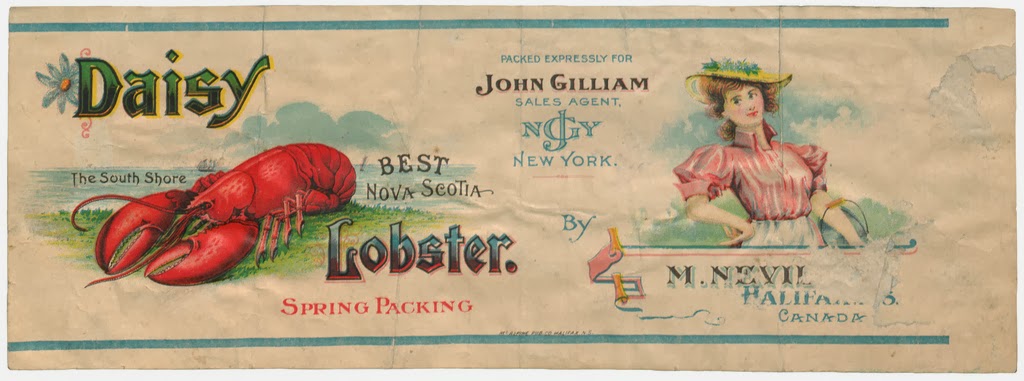
A Taste of Lobster

The people working at the Nova Scotia Archives are wonderful-- not only do they have in their collection a scrapbook of labels from canned lobsters (1880-1938), they recognized the quirky, colourful appeal of these labels, digitized them, and shared them on the Flickr Commons. You are awesome, folks of the Nova Scotia Archives. 

As, I would say, are these lobster labels:


Nova Scotia Archives


Nova Scotia Archives


Nova Scotia Archives


26 June, 2013

Banff in Former Days

Especially with the terrible flooding in Alberta, and especially because I'm originally from there, I thought it would be a good time for some beautiful pictures from the province.

Banff, in the Rocky Mountains, has been a tourist destination since the 1880s. The incredible Banff Springs Hotel has been around almost as long, going through a few renovations in the progress. I've put these in mostly chronological order, because I think it's fantastic to see how the landscapes (and the views photographed) stay the same, while the hotel and town change.

(By the way, that river going through the valley is the one that's currently on top of Calgary...)


Musée McCord Museum

The Banff Springs Hotel, about 1887. Source


Musée McCord Museum

The Bow River Valley from the Hotel, 1887. Source


Musée McCord Museum

The Bow River Falls, 1887. Source

03 June, 2013

"Tobogganing"

This isn't perhaps the most suitable post for early June, but I just came across these and they are far too wonderful to wait until it snows again. 

So it's the 1860s and you live in Quebec, and since you live in Quebec you really love to toboggan. You love it so much that you really want your picture taken while doing it. However, it's the 1860s and cameras are far too slow to capture motion, as well as very cumbersome to take outdoors, especially when it's minus three hundred degrees. What do you do?

The answer, of course, is obvious. You go to the photographer William Notman in Montreal, who provides the fake slope, fake snow, and fake sleds in his studio. All you have to do is dress up in your toboggan clothes and maybe pretend to crash now and again.

Dates range from 1866-1892, with a particular surge in 1869-70. All by William Notman or his studio. 


Musee McCord Museum


Musee McCord Museum


Musee McCord Museum


25 February, 2013

Action on the Western Front

The misery of World War One is a recurring theme in this blog, with the implicit question "how could they make anyone go through this hell?". Today we have a new installment, from a new source. The majority of World War One photographs here have been official British photographs (from the National Library of Scotland), made within specific guidelines to be published in the press. While there are nonetheless some striking action shots, and the overall misery can't be denied, their depictions of the war are heavily influenced by the vision the government wanted to project--a), that these men are heroes, and b) overall it's not that bad. Most action scenes are posed and/or performed for the camera in back-line trenches.  Well-fed and smiling faces are emphasized, as are peaceful scenes. Most photographs of wounded soldiers emphasize the care they are given. Dead bodies are always identified as Germans; the British dead are pictured only in graves. We've looked also at some Australian WWI photographs, American ones, and even French autochromes, all fitting into this trend. 

Recently, though, I found a set of Canadian WWI photographs, from Library and Archives Canada (who are on Flickr, but not the Commons). Though the named photographers-- William Ivor Castle, Henry Edward Knobels, and William Rider-Rider-- were official photographers, there seem to be quite a few different kinds of views. Notably there are more action shots, taken under fire, more similar to later photojournalist war photography. (even if, as should be noted, shots were sometimes altered-- shrapnel bursts from one photograph's sky might have been added to that of a another). Overall there seems to be a more frank depictions of the honesty of war than in the British official photographs, which I feel is worth a long look.


Library and Archives Canada

Troops dig themselves in while shrapnel bursts overhead, Vimy Ridge, 1917. Source


Library and Archives Canada

A tank in a muddy, shelled landscape, Passchendaele, 1917. Source


Library and Archives Canada

The battlefield near Courcelette, October 1916. Source

01 July, 2012

Dominion Day!

Views of Canada for its 145th birthday!

HAPPY CANADA DAY!

For more cross-country tours, see Oh, Canada and Oh, Canadian Cities (and here's some fireworks!). 

These photos mostly from the Musee McCord Museum, with a few from the collections of the IWM and LIFE. 


The beautiful Chateau Lake Louise, Alberta, 1946.  Source


Winston Churchill and his daughter at Niagara Falls., 1943. Source


Percé, Quebec, c. 1900. Source


23 January, 2012

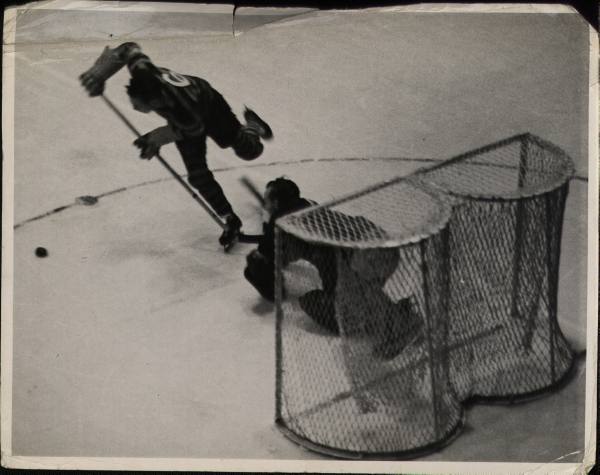
The Hockey Game

Let's play (ice) hockey!


Hockey game at McGill, Montreal, Quebec, c. 1910. Source


Boys playing hockey in Dawson, Yukon, Canada, c. 1900. Source


Hockey game at the Victoria Rink (composite photo), Montreal, QC, 1893. Source


A goalie at a game in 1951. Source


Undated. Source


Anglo-American hockey team, St. Mortitz, Switzerland, c. 1900. Source


Hockey at Engelberg, Switzerland, c. 1910. Source


Hockey game at the Winter Olympics, Squaw Valley, California, 1960. Source


1951. Source


A hockey game in Quebec, 1952. Source


A hockey team, c. 1910 (no location given). Source


The Maple Leafs play the New York Rangers at Madison Square Gardens, 1948 (the goalie is the Leaf). Source


The Shamrock hockey team, Montreal, Quebec, 1899. Source


Renzoni and Regina hockey teams in Dawson, Yukon, Canada, 1910. Source


Undated (love the stripey socks in these old ones!). Source


Undated. Source


A save during a game in 1954. Source


1951. Source


Undated. Source


Game in Spokane, Washington, US, 1954. Source


An ice hockey team in Sydney, Australia, 1937. Source


McGill hockey teams, Montreal, 1902. Source


Women playing hockey in bathing suits (why? no idea), Minneapolis, Minnesota, USA, 1925. Source

Related Posts Plugin for WordPress, Blogger...

Search This Blog