History with its flickering lamp stumbles along the trail of the past, trying to reconstruct its scenes, to revive its echoes, and kindle with pale gleams the passion of former days. ~Winston Churchill

Showing posts with label biplanes. Show all posts

24 November, 2014

Flying, 1920s Style

A terrific set of cigarette cards depicting a flight from London to Amsterdam in the early days of commercial air travel. The images (each "from an official photograph supplied by Imperial Airways") are accompanied by text detailing "our" flight, from check-in and take-off, to views over the Channel, France, and Brussels (where we land for lunch), to the final landing in Amsterdam. I've included the backs with the text, as the little details are fascinating insights into a time when planes held "as many as" 20 passengers, reached cruising altitudes of 3,000 feet, and got from London to Brussels in "only" two and a half hours. 

(The cards aren't specifically dated, but Imperial Airways existed from 1924-1936, the plane named (the [Armstrong Whitworth] Argosy) was used from 1926-1935, and the clothing is solidly late 1920s)


New York Public Library

New York Public Library

Check-in ("weighing-in"). Source


New York Public Library

27 May, 2014

Through the Camera Gun

For World War One pilots and observers, a crucial part of training was learning how to accurately operate a plane-mounted machine gun, while flying, with moving targets. Of course actually shooting at the other student pilots wouldn't work, so they came up with a solution: camera guns. The camera gun resembled the regular machine guns used on airplanes, but firing the shutter exposed a frame of film (for more details and pictures, see here).  The film would then be developed and the accuracy of the aim could be assessed by the position of the target as captured by the shutter. 

The photographs themselves were, of course, not the aim of the endeavour. Exposure, aperture settings, and focus were fixed, and the shots were disposable. I'd actually never seen an example until I stumbled across these images in the collection of the San Diego Air and Space Museum. They come from the personal photographs (possibly in album form; it's unspecified) of an American air force pilot named Frederick H. Morlan who served and just after during WWI. Apparently he liked them enough to keep them!


San Diego Air and Space Museum


San Diego Air and Space Museum


San Diego Air and Space Museum

Though the camera guns were of course intended only for target practice, pilots sometimes took pictures just for fun. Peter Hart's book on WWI pilots Aces Falling contains an anecdote of a young pilot who got in trouble for flying where he shouldn't have been... because he took a picture of it! Source

27 April, 2014

Through Biplane Rigging

I'm extremely fascinated by snapshot photos taken from the cockpits of WWI biplanes, as I've posted several times. I love the fact that a lot of these guys really wanted to take pictures up there, just for fun (these are all from training, when this was possible). Often you can tell from the position that it's the pilot taking the pictures, too-- not as easy with a Vest Pocket Kodak as with an iphone or even a Leica, especially when you're flying what is essentially a kite with an engine. But some of these fellows just loved doing it, and filled albums with their photos (a couple favourite examples). 

One of the things I love to see in these pictures is the unintentional aesthetic created by the limited position of the photographer. Wings and rigging are caught in shots of the landscape or other planes, crisscrossing the scene, cutting it up or sometimes framing it. I think the rigging and wing interference shots are amazing both for the way they ground us in the place of the photographer, and for simply looking cool.

All but one from two albums by different pilots at training air fields in Texas during World War One. 


San Diego Air and Space Museum

This one fellow often captions the photos in his albums--thanks to SDASM for including these! Source


San Diego Air and Space Museum


San Diego Air and Space Museum

The Grand Canyon, 1931. Source

28 March, 2014

Wing Walking

Wing walking, of course, is one of the crazy stunts pilots got up to in the earlier days of aviation. It is still done sometimes, but with wires and straps and thing to make sure the practitioners won't die. Back in the days these photos were taken, there were no such safeguards. Pilots would simply climb out of their cockpits and stand, sit, or hang from the wings or fuselage. This kind of thing was very popular in stunt shows of the 1920s, though it was being done for fun much earlier.

The majority of these photos depict an American barnstormer of the 1920s named Carter Buton, whose antics are documented in scrapbooks temporarily held by the San Diego Air and Space Museum. However, the albums of WWI pilots-in-training yield plenty of examples at least as daring, done just for the benefit of fellow pilots, and/or just for the hell of it.

If you're afraid of heights, you might want to click away now...


San Diego Air and Space Museum

Carter Buton, 1920s. Source


Deseronto Archives

RFC pilot and flight instructor Lt. Ned Ballough, known as the "wing walker", Ontario, WWI. From this album. Source


Deseronto Archives


Lt. Ned Ballough again, Ontario,WWI. Source

16 May, 2013

Portraits from the Cockpit

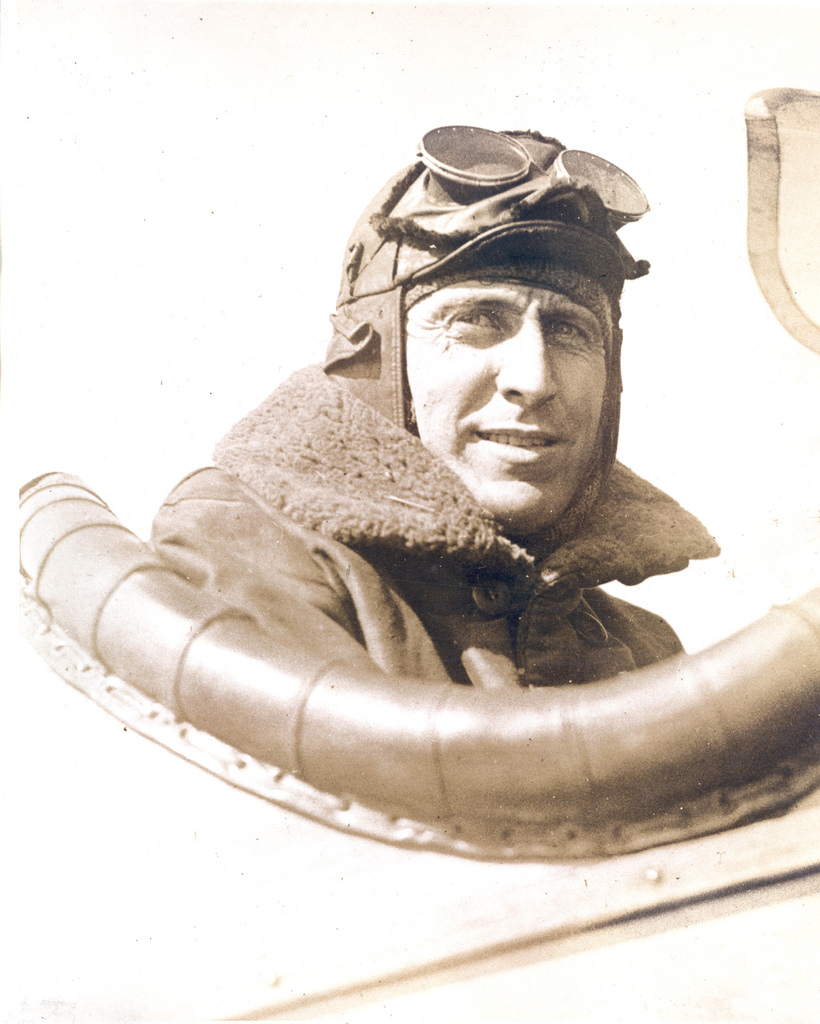
We've seen some of the photographs WWI era pilots took of each other's planes whilst aloft; today, the photographs they took of each other in the air! A lot of these are taken by the pilot of the other guy in the plane (usually an instructor, as all are from training airfields), though a few are from the other guy of the pilot. I think these are amazing. I love the fact that these (very) young guys took cameras up into the air to take pictures of each other. I love that they did this despite the fact that these cameras (probably Vest Pocket Kodaks) can't focus below about six feet and have slow-ish shutter speeds and I love the fact that they still managed some good pictures. I love picturing a biplane pilot turning away from the dashboard to snap a picture of his friend (most of the instructors weren't much older than the pilots). I just love them. 

From two seperate collections of the San Diego Air and Space Museum: the collection of Walt Claverie, a pilot who trained in 1912 and taught at Selridge and Rich Fields during WWI; and an album belonging to Paul Aldin Smith, a pilot training at Kelly field in Texas during WWI. Both are terrific views of life as an aviation student and are highly reccomended. 


San Diego Air and Space Museum

I think this might be Walt Claverie; looks like him (he's adorable, by the way). Source


San Diego Air and Space Museum


San Diego Air and Space Museum


01 January, 2013

Aeroplanes Aloft

Photographs of WWI airplanes in the air, including tricks and antics that the young pilots were encouraged to do. These are from an American aviation training field in Texas, 1917-18. I think most of the planes are training models but I've no idea, if anyone has expertise do share!

The San Diego Air and Space Museum recently uploaded a whole heap of WWI photos, mostly aviation related--they're not in very good condition but there's an incredible variety.


San Diego Air and Space Museum


San Diego Air and Space Museum


San Diego Air and Space Museum


04 January, 2012

Airshows with London Transport

Today, London Transport suggests we take in an air show! From 1908 through the 20s and 30s Hendon Aerodrome was the place to go, situated a few miles outside London's northwest city limit at the time (the area is well inside London's suburbs now). From World War Two onwards activity at the aerodrome declined and it was closed in 1968; however, the RAF museum still lives there, if these posters inspire a visit. Art Deco biplanes certainly tempt me...


Poster by Charles E. Turner, 1924. Source


Very early flying planes at Hendon--1913! Poster by Tony Sarg. Source


Another early advertisement for the fun of aeroplanes, 1914. Also by Tony Sarg. Source


Poster by Henry Perry, 1931. Source


Poster by Charles Burton, 1930. Source


Poster by Charles E. Turner, 1925. Source


Poster by Charles E. Turner, 1928. Source


All right, this one is slightly frightening, especially in light of later events in London... Poster by Andre Eduoard Marty, 1933. Source


Poster by Zero, 1935. Source


Poster by Edward Albert Halliwell, 1929. Source


Poster by Dora M. Batty, 1932. Source

04 June, 2011

By Air Mail

More photographs of those postal men and their flying machines. The sequel, of course, to this blog's first airmail post .


The first day of airmail service in the United States, May 15, 1918, with pilot Lt. Torrey Webb. Source


Unloading the first airmail plane to fly across the continent in 1924, at Omaha, Nebraska. Source


Pilot Eddie Gardner with his plane, 1918. Source


Pilot Robert Shank (one of the first four airmail pilots) after a crash, 1918. Source


The airmail field and hangar at Omaha, Nebraska, 1927. Source


Airmail plane taking off, undated. Source


Photograph of pilot Arthur Roy Smith, who flew for the airmail service from 1923 until his death in a crash in 1926. Despite the skill of the pilots, crashes were sometimes unavoidable and several pilots were killed in the decade of airmail.  Source


Pilot John F. Milanzo, c. 1924. He flew with the airmail service from 1923-1927, when he sadly became the last pilot killed while working for the airmail service, his plane crashing in an April snowstorm. Source


Pilot Lt. James Edgerton and his sister, 1918. Edgerton was one of a group of army pilots who were the first to fly mail for the Postal Service. Source


Pilot William Carroll, c.1921. Sadly, in February of that year he and two other men were killed when their airmail plane burst into flames and crashed. Source


Pilot William C. Hopson in winter flying gear, c.1926. Source

16 April, 2011

Par Avion

Possibly the thing I love the most about adventuring through online archive collections is how you can come across something you never would have thought to look up, and never would have thought you'd find interesting, and then be fascinated. There's something about seeing the faces and scenes of days gone by that's just so compelling [I've started to think I really should have studied modern history!]. Of course today's post is a case in point. I was skipping through the Flickr Commons and came across the first photograph here, thought it was great and turned to the collection it's a part of -- and become fascinated with the early days of airmail in the United States!

A very quick context-- airmail service started in May 1918 between major cities on the East Coast, initially using army pilots and planes. By 1924 trans-continental service had been introduced, with the advent of lighted runways-- important when it took 30 hours to cross the country by plane!

All right, on to the really interesting bit-- as ever, the pictures. All from the Smithsonian Postal Museum, with more details on the linked pages.


Airmail plane landing in a snowstorm, 1920. Source


A group of men and pilots with plane. Sitting on the plane is Eddie Gardner, one of the first airmail pilots. 1918. Source


Army Air Corps pilots Major Reuben Fleet and Lt. George Boyle, some of the first to fly airmail. The two of  them are admiring Fleet's watch -- each of the army corps pilots was presented with a new watch in honour of their historic flights. 1918. Source


A posed photograph with the postmaster general and a military officer presenting pilot James Hill with a ceremonial bundle of mail for the very first scheduled transcontinental airmail flight. July 1, 1925. Source


And, well, not all the flights went so well. A crashed airmail plane in 1918, with pilot Lt. Webb (who was obviously all right, luckily!) climbing the body. Source


Airmail pilot Dean Smith, c. 1924. The Smithsonian has an interesting (and lucky!) story about him which I recommended reading here [which is, of course, also the source]. 


An autographed photograph of pilot E. Hamilton Lee, taken in the 1920s but signed 1949. Lee flew with the Post Office for most of 1918-1927, and then with United Airlines until he retired in 1949, having flown longer and farther than any other living pilot. Source


27 March, 2011

Up in the Air, 1915

Today's photos don't actually feature people, but I feel these photographs bring one closer to the experience of being a pilot in the First World War than anything else could, and I find that experience fascinating. Half are from the National Library of Scotland's collections, while the others come from the Dutch National Archive [many thanks to the Flickr Commons for introducing us!]. I get quite a lot of feeling from these photographs, and I hope my readers will too.


A surveillance flight over the German lines. Source


And again. Source


Third in that series [I'm sure these were all the same flight]. Source

Biplane stuck in a tree, 1915. This photograph emphasizes how delicate these early planes were, almost kites! You can see the pilot getting out of the cockpit and another man climbing up to help him. Source


Related Posts Plugin for WordPress, Blogger...

Search This Blog